
Written by Ezderm Team
⚙️Blog post settings
⚙️Anchors settings
For dermatology practices, every software purchase starts with a promise: Better scheduling. Better collections. Better patient engagement.
However, the reality is often strikingly different. With each platform comes a new vendor, with their own support practices, implementation timelines, and industry-regulated restrictions.
In this blog, we take a closer look at the 5 hidden costs of juggling too many vendors, what consolidation actually looks like, and how your practice can begin its journey to back office success.
The Vendor Sprawl Problem in Dermatology
Vendor Sprawl
NOUN • ven·dor sprawl • /ˈven-dər sprȯl/
Definition: The gradual accumulation of multiple software vendors and disconnected technology platforms within a medical practice. Vendor sprawl develops as practices adopt separate solutions for scheduling, billing, patient communications, payments, reputation management, and other operational needs—often without a long-term strategy for how those systems will work together.
Over time, managing the vendors themselves becomes just as challenging as managing the software, creating unnecessary complexity, fragmented workflows, duplicated effort, and rising operational costs.
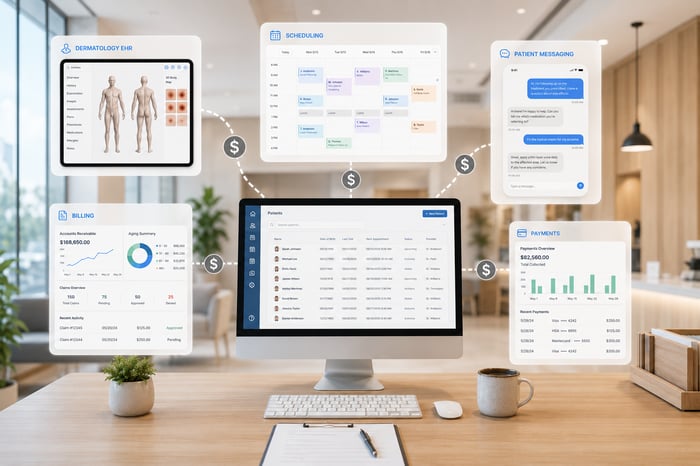
This usually includes common systems and vendors like:
- EHR vendor
- Billing vendor
- Texting vendor
- Payments vendor
- Scheduling vendor
The cost of having a different vendor per platform isn’t small. In many cases, these systems weren’t designed to integrate without additional effort--sometimes from both vendors--which can result in a disconnected back office wreaking havoc on your practice’s operational performance and processes.
5 Hidden Costs Most Practices Never Measure
Hiding in the gaps between systems and vendors are 5 costs that many practices haven’t considered.
Hidden Cost #1: Staff Time Is Spent With Systems, Not Patients
With disconnected systems and vendors who are unfamiliar with each other’s products, your practice’s staff may find themselves taking on the work of being bridges between your tech stack.
This can look like:
- Staff is working double and triple time to input patient records, payment preferences, appointments, and provider schedules.
- Providers spend 2.5 hours on data input for every 1 hour spent with patients.
- Creating dermatology-specific templates by hand results in hours spent on software support instead of patient support.
- Burnout tracking at a whopping 40% across the practice.
Hidden Cost #2: Data Risks and Errors Increase
With multiple systems and vendors powering your back office, the risk for data and PHI compromise increases. Dermatology PHI, like much of the same information across other healthcare specialties, is at a high risk of cybercrime. If your practice is relying on a high number of systems to maintain this information, you’re offering cybercriminals multiple points of entry to access this information.
Additionally, if staff manually move between platforms and vendors, the risk of data entry errors increases significantly. Automated and AI-assisted clinical tools report a 2-5% clinical documentation error rate--manual data entry increases that risk to 10-15%. This can result in left-right and anatomic site mapping mistakes, pathology and biopsy mix-ups, and copy-and-paste propagation.
Hidden Cost #3: Increased Training Requirements
It’s no surprise that every vendor and system operates a little differently. Relying on a diverse mix of platforms means staff have to be trained on each one individually.
This may result in problems like:
- Increased risk of scope-of-practice violations: For cosmetic dermatology practices, shifting tasks to unverified or insufficiently trained staff members can result in adverse patient outcomes like burns, unnecessary scarring, and more.
- Workforce shortage and burnout: Requiring staff to be able to comfortably juggle multiple systems and vendors can deter new hires and overwhelm existing employees during training, leading to higher turnover rates.
- Liability and regulatory penalties: Delegating clinical or aesthetic tasks requires strict physician supervision agreements and adherence to state laws. If the majority of staff time is consumed with training and software management, it’s all too easy to leave your practice vulnerable to legal action and regulatory fines.
Hidden Cost #4: Support Ticket Chaos
Relying on a large number of dermatology software vendors can quickly turn into the age-old question of “who’s on first, who’s on second?” No business wants to take the full blame for late payments or denied claims.
Additionally, disconnected vendors may not have insight into the full scope of your practice. Their specific system may not be built specifically to support dermatology-specific workflows, while another platform in your tech stack is.
Common frustrations you may face in this area include:
- Slow vendor response times: Larger EHR vendors support a wide variety of medical specialties, often measure non-critical support response times in days, causing operational bottlenecks for your practice.
- Third-party disruptions: Vendor-side cybersecurity incidents, outages, or server downtime can paralyze your practice’s ticketing and support options.
- Vendor scalability: Outdated software, lack of customization options, and slow feature request fulfillment can slow your office processes to a crawl.
Hidden Cost #5: Fragmented Reporting and Decision-Making
Tied into this lack of communication between your vendors and platforms is fragmented reporting and decision-making. With staff having to manually move information between systems, it’s all too easy to have a bit of a patient’s chart in the EHR, another note about their payment preferences in your payment platform, and their insurance information elsewhere.
This decentralization means no one--not even your office manager or lead provider--has a full and complete picture of what’s actually happening with your practice’s crucially important data. This lack of knowledge negatively impacts all aspects of any decision-making processes you may need to implement. After all, how can you know that you need to update your billing software if relevant information is stored in your payment processing solution?
What Consolidation Actually Looks Like
If your practice is experiencing any of these vendor-sprawl-related headaches, it may be time to consider consolidation. Here’s what that may look like for your practice:
Fewer Vendors
Downgrading or discontinuing service with a long-time vendor can be a daunting process. But if the software they provide is no longer serving you--or your patients--this move is likely necessary. There are a few paths you can take to de-clutter your vendor list.
- Identify which of your current vendors and systems are actually helping your practice operate. Do they partner with any other systems? Can they seamlessly integrate with any of your existing platforms? Can they work with your practice to find a smaller, better tech stack?
- Evaluate leaving your disconnected set of vendors and systems entirely. Identify potential replacements that offer an all-in-one solution for your practice--a vendor who can support your EHR, payment, billing, scheduling, and texting from one platform.
Integrated Workflows
With a more connected or all-in-one solution, many of the headaches your staff face with inefficient workflows resolve themselves. Gone are the hours spent manually moving patient records between your EHR and your payment processing platforms. With better integrated workflows, important and sensitive patient information flows pain-free through your back office.
Optimized workflows reduce administrative work, improve communication, and allow staff to spend more time supporting patients rather than on the systems they need to do their jobs. The guesswork about whether information is accurate or up to date is eliminated, reducing stress and frustration.
One Centralized Hub of Information
An all-in-one solution offers many benefits, including a centralized hub of all practice information. Not only does this make record retrieval, data management, and efficient billing easier for your back office staff, but it also lessens the risk of severe financial setbacks.
The chances of protected PHI being stolen lessen with only one point of access into your practice’s back office. The risk of being hit with HIPAA violations for unauthorized staff members viewing or managing patient records is also under tighter control.
The Benefits of Reduced Vendor Sprawl for Your Dermatology Practice
We’ve now uncovered the hidden costs of relying on too many vendors for dermatology practices just like yours.
With these costs identified, we can now also see the benefits of finding ways to reduce your number of vendors--and in some cases, all the way down to one unified platform that provides your staff and providers all the technological support they need to provide patients with the high level of care they’ve come to expect.
If your practice is looking for more information about what too many vendors can do to your practice--and how Ezderm can serve as a solution to this “Frankenstack” of systems, check out our new guide!
Download our Ditch the Frankenstack guide to learn how leading dermatology practices identify vendor sprawl, uncover hidden inefficiencies, and build a more connected approach to practice management.
Meet the author

Ezderm Team
Ezderm staff writers create educational content focused on the real-world needs of dermatology practices. Our articles are developed in collaboration with dermatology professionals, product specialists, and revenue cycle experts to help practices improve workflows, financial performance, and patient experience using modern technology.

.jpg?width=406&height=270&name=Mask%20group%20(1).jpg)