Claim denials, late payments, and billing rework are frustrating enough on their own. When they keep happening, the problem usually isn't the staff - it's the technology. Not every EHR or revenue cycle management (RCM) platform is built for dermatology, and general-practice systems regularly miss the specialty-specific steps that catch errors before they reach the payer.
Here are seven features worth looking for when you're comparing platforms, along with questions to ask vendors when you want straight answers.
1. Dermatology-Specific Coding Built Into the Chart
General EHRs require billers to search broad ICD-10 and CPT libraries manually, which leaves room for miscoding - especially for complex derm encounters involving multiple lesions, staged procedures, or cosmetic services billed alongside medical ones.
In Ezderm, coding isn't a separate step. The 3D Body Map is integrated with ICD-10, CPT, and SNOMED databases. When a provider applies a treatment plan to a mapped lesion, the system generates the location-specific codes for that encounter automatically. E&M coding follows from the documentation itself. No manual lookups, no copy-and-paste between screens.
Mismatched diagnosis-to-procedure codes are a leading cause of claim denials in dermatology. When coding comes out of the clinical workflow rather than being added on afterward, errors get addressed before a claim goes out.
Ask vendors: Does your coding library auto-suggest codes based on the documented procedure and lesion site? How does it handle encounters with multiple lesion locations?
2. Isotretinoin Management and iPLEDGE Compliance
Managing iPLEDGE outside the EHR - through a separate portal, a spreadsheet, or staff memory - is a compliance gap. When patients miss a monthly check-in or a provider prescribes before enrollment is confirmed, the risk falls on the practice.
Ezderm's isotretinoin module handles iPLEDGE documentation, automated dose calculations, lab result monitoring, and patient reminders inside the same EHR workflow providers are already using. There's no toggling between systems, and staff aren't responsible for manually tracking where each patient stands.
On the billing side, missing or incomplete isotretinoin documentation creates downstream problems. If a patient's status isn't properly recorded at the time of the visit, it can lead to coding gaps that complicate claim submission.
Ask vendors: Is iPLEDGE status visible directly in the patient chart? Does the system flag patients who are overdue for compliance steps or lab results? Can it auto-calculate dose adjustments based on weight?
3. Automated Insurance Eligibility Verification
Checking eligibility the morning of a visit - or at checkout - is reactive. By then, if a patient's coverage has lapsed or changed, the practice is already in the position of chasing payment it may never collect.
Ezderm's practice management system verifies coverage in real time and runs batch eligibility checks in advance, re-validating upcoming appointments and flagging terminated or changed plans before the patient walks in. Front-desk staff can see co-pay amounts, deductibles, and coverage limits before the visit begins.
Denials tied to inactive coverage or incorrect subscriber information are common and preventable. Catching them at scheduling or check-in is significantly cheaper than working them after the fact.
Ask vendors: When does eligibility verification actually run? Does it show benefit details like co-pays and deductibles, or just active/inactive status?
4. Claim Scrubbing Built for Derm Billing Rules
A generic claim scrubber catches formatting errors and missing fields. What it won't catch are the payer-specific rules that apply to dermatology: cosmetic versus medical procedure distinctions, multiple-procedure reductions, biopsy-related coding requirements, or modifier rules that vary by plan.
Ezderm builds billing-ready encounters directly from signed clinical notes. The built-in scrubber pre-flags missing payer information, inactive insurance, and invalid codes before submission. Claims go out through Availity. Modifier automation handles common adjustments, and a provider-to-biller messaging feature gives billers a channel to resolve discrepancies before anything leaves the practice.
A claim can pass a generic scrub and still get denied at the payer level. That second review layer, informed by how dermatology actually bills, is where the difference shows up in first-pass resolution rates.
Ask vendors: What specifically does your claim scrubber check for? How does it handle cosmetic versus medical billing to prevent accidental insurance submission?
5. Denial Management With Reason-Code Tracking
Denials happen at every practice. The question is whether the system helps you understand why, or just hands them back for staff to work.
Ezderm's practice management includes aging reports with denial reason codes and full claim status tracking across all stages: ready, pending, denied, rejected, patient responsibility, and completed. Every adjustment, write-off, and follow-up note is documented in the system. Whether the billing is handled in-house or outsourced, that paper trail makes it possible to identify recurring patterns and address them before they repeat.
Ask vendors: Can you pull a denial trend report by reason code? How does the system track a denied claim from initial filing through resolution?
6. Pathology and Biopsy Log Integration
High biopsy volume is a given in dermatology, and the billing workflow for path results is one of the more common places charges go missing. Results need to be tied to the right encounter, documented correctly, and coded with the right CPT codes - steps that are easy to miss when the lab workflow lives outside the EHR.
Ezderm's pathology and biopsy log connects directly to the 3D Body Map, linking results to the exact lesion site that was documented at the visit. Lab results post into the EHR without manual reconciliation, and the log filters by status, type, or date. For practices working with Sonic Healthcare (Aurora Diagnostics) or Quest, Ezderm has direct integrations so the loop stays closed from order to result to billing.
Ask vendors: How does your system connect pathology results to the original encounter? Is the billing workflow triggered automatically when results arrive, or is that a manual step?
7. Real-Time RCM Performance Reporting
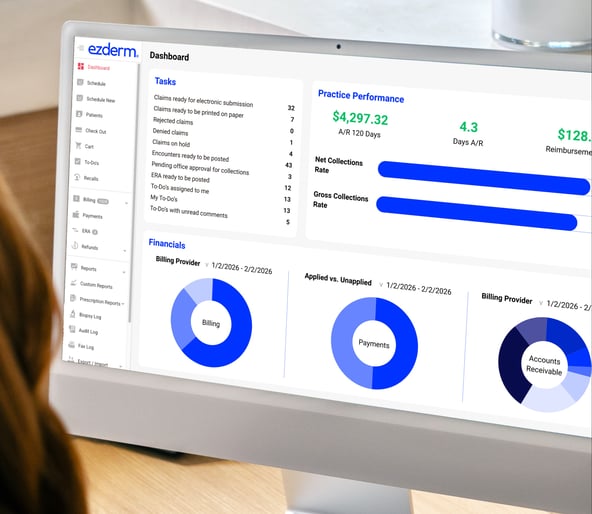
Net collection rate. Days in A/R. Denial rate by payer. These numbers tell you whether your revenue cycle is working - but only if you can see them when it matters, not at the end of the month.
Ezderm's practice management includes real-time financial dashboards with revenue tracking by provider, payment type, and location. Practices on Ezderm's full RCM service get dedicated monthly reviews alongside that day-to-day visibility. The performance numbers reflect it: Ezderm RCM averages 98% net collections, keeps greater-than-90-day A/R below 2%, and holds average days in A/R at around 14.
Ask vendors: What financial reports come standard? Can I see A/R aging, denial rates, and collection performance by provider and payer without a custom report build?
Why Integration Is the Real Variable
Each of these features is more effective when it's connected to the others. The practices that see the most consistent improvement in denial rates and collections aren't necessarily the ones with the most staff or the most aggressive follow-up - they're the ones where the EHR documentation feeds directly into the billing workflow, with no manual handoffs in between. That's what a dermatology-specific, integrated platform is built to do.
Want to see how Ezderm handles these workflows end to end? Explore Ezderm RCM.