

Table of Contents
After completing the comprehensive business plan for your dermatology practice, you are ready to examine options for funding it. This funding will cover your startup costs and overall practice operational expenses, which include office space, equipment, and staff salaries. With the right investment capital, you will be able to start your business and expand it as your revenue increases over time.
Considering the numerous options for financing, the strategy of your practice that you’ve outlined in your business plan should guide your decision-making around medical practice funding. This includes the type of office environment you want to create, the type of services you will provide, the expected patient volume, and your personal approach to finances—among other factors. One thing is certain: capital is the primary means by which dermatology entrepreneurs are able to invest in their business and pursue their dreams.
Funding considerations
As you weigh available funding options, it is prudent to gather the materials you will need to present to potential lenders. This includes your comprehensive business plan, which should detail your business model, legal structure, operating plan, anticipated start-up expenses, and financial projections.
Regardless of which funding method ends up forming the financial foundation of your dermatology practice, it is important to keep in mind that the first few months of operations will likely bring in limited revenue. This is due to the nature of the insurance claims cycle and also accounts for time needed to grow your patient base. Be sure to plan to yield little to no revenue for the initial three months, ensuring that you secure enough capital to both kick off the business and operate the practice over this period of time. As noted in the section, Developing a Comprehensive Business Plan: Detailing Your Dream, it is important to limit your costs and expenses during this initial start-up time frame. Also be sure to factor in how loan repayments will contribute to regular monthly expenses.
In addition to sharing business plans and projections with potential lenders, you will likely need to supply legal documentation including professional credentialing, business registration, and any agreements you have already set for office space or equipment. Practice credentialing can take upwards of six months, so it is important to begin the licensing process early. Similarly, lenders will inquire about medical malpractice insurance; explore options to protect yourself and manage risk with plenty of lead time and secure a plan as the practice nears opening.
Available borrowing options
There are a multitude of options for securing medical practice funding. While many physicians seek out bank loans, funding from financial institutions is just one of many options available. A wide variety of loans, terms, and lines of credit can fund your business. Further, some entrepreneurs are self-funded, meaning they draw from personal savings to start a practice, or join forces with a partner or investor.
If opening a practice with one or more partners who are pooling resources together, it is important to agree on the terms of the partnership and compensation among parties. Consider how the equity will be distributed among contributors, and how the partners in practice will share the work—sweat equity. To ensure smooth operations, decide upfront how the capital, workload, and profits will be distributed, and detail everything in writing.
If seeking external resources for medical practice funding, traditional bank or credit union loans are common; rates vary based on current economic conditions, personal credit history, size of the loan, and the lender’s risk assessment based on your business plan and overall profile. Financial institutions offer a variety of loan options—both secured and unsecured—and many of them are quite reasonable assuming the borrower has a solid credit score (in the mid-600s or higher) and low debt-to-income ratio (35% or less). The earlier you establish a relationship with potential lenders, the better. Get to know bank representatives ahead of or during the application process so you can demonstrate your commitment to the business and establish open dialogue about intentions and plans.
"Seek funding locally. From our experience, the best lending opportunities come from building relationships with a local banker who knows you personally. Bankers like to lend to doctors because their high earning power reduces the risk of defaulting on the loan."
—Tony J., Michigan
Small business administration (SBA) loans are similar in that borrowers apply for funding from a traditional bank or credit union. These loans are backed by the government up to 85%, allowing for more favorable interest rates, fewer fees, and longer terms for repayment. SBA loans do, however, take up to three or four months to secure and involve a healthy amount of paperwork in the application.
Term loans are a good back-up plan when traditional or SBA loans are not feasible. These loans provide a lump sum of capital at a fixed rate that generally requires repayment within a year at fixed intervals; short-term, intermediate-term, and long-term loans are available. Usually, the limits for term loans are lower than traditional longer-term arrangements, so these are more often used for purposes like expansions and equipment upgrades than start-ups.
A business line of credit allows you to draw against a determined credit limit over time versus securing a lump sum. This quick access financing option ensures you can secure exactly what you need—and only pay interest rates on what you end up using. Similarly, dermatology entrepreneurs also may consider a home equity line of credit (HELOC), which leverages personal assets in the same way to fund practice start-up costs or ongoing operational expenses. It is important to review your options with a financial advisor to understand each type of financing to find what works best for your vision.
After weighing all available lending options—especially the pros and cons of the terms—you will provide the documents, materials, and background information as requested for submissions of applications. Be ready to communicate the value of your practice to prospective lenders. After receiving funding offers, review the terms and conditions in detail, and negotiate with the lender to optimize the impact of the loan with respect to what you need to run the business.
"A major trip point is over-borrowing. Don't allow your banker or any advisor to sell you on a plan that does not work for you but makes them more money. Borrow what you project you need and not a penny more."
—Tony J., Michigan
Managing funds wisely
Ideally, the funding you secure based on accurate, sensible budget and revenue projections ultimately meets your business’s financial needs. Unfortunately, some entrepreneurs discover that unexpected expenses arise and accrue, creating a scenario where more funding or additional revenues are needed to sustain the practice. Capturing additional revenue streams in the form of Mohs surgery, dermatopathology services, or direct-pay cosmetic services, to name a few examples, can serve to cover higher-than-anticipated expenses or expand the business.
To mitigate high practice expenses, consider how you can manage funds wisely to optimize operations on all levels, including payroll costs and both fixed and variable office management expenses. Consider how investments in dermatology equipment, medical and telehealth technology, patient engagement tools, or practice management software can positively affect your bottom line.
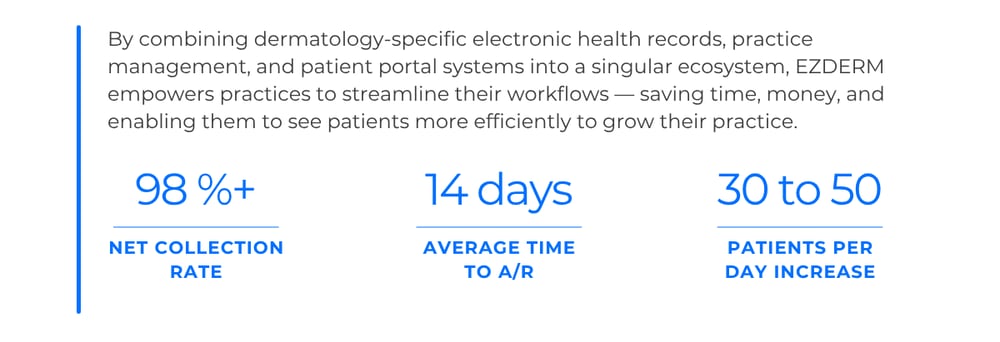
It is also wise to identify opportunities for consolidating software, which can drive productivity, eliminate redundancies, and free up staff via streamlined practice management related workflows. In the dermatology industry, a piecemeal approach that uses various point solutions can cause interoperability challenges and other difficulties with managing multiple vendors’ policies, fees, and terms.
To save on costs and improve the user experience, it may be worth an initial investment with one trusted vendor partner who meets your business and operational needs including revenue cycle management, EHR, practice management, patient portal, and check-in via one consolidated offering. For billing, in particular, integration enables significant time savings and error reduction, which actually enhances revenue through improved collections. In general, investing in current technology — particularly with applications leveraging AI and integrated software tools — is an asset in private medical practice that enables cost and time savings, minimizes errors, optimizes performance, and improves the patient experience.
Securing dermatology practice funding demands a nuanced understanding of financial planning and business development. It is also the precursor to important decisions about the office location and/or environment, staffing, technology resources, marketing, and patient retention, among other dermatology-specific practice needs that we will explore in the next sections. As you grow your practice and network, your financial needs will change — so, too, will your revenues. Keep in mind, securing funding is an achievable objective; administration of funds over the long term requires ongoing management rooted in diligence, discipline, sound decision-making, strategic planning, and adaptability.